
Your Bristol student accommodation search starts out simple: find a room, check the rent, and book it before someone else does. Then the listings start piling up. One has a private bathroom, another has a shared kitchen, another's closer to campus, and suddenly you're wondering what you'll actually be paying for and what living there will really be like.
That's usually the point where things get complicated, once you've opened a handful of student properties in Bristol. A place can look great in photos but have completely different bills, contract terms, travel times or living arrangements from the next one.
Budget matters, but so does your day-to-day routine. Maybe you want your own space to focus on studying, or you'd rather have people around, or you just want something that makes getting to university and managing daily life easy.
This guide covers the practical things to consider before choosing a student home in Bristol, from property types and accommodation costs to facilities, study space, travel and contract terms. If you're wondering what amenities to look for in student accommodation, or how to compare different places before renting, these checks will help you make a more informed decision.
Know Which Type of Student Property You’re Looking For
The first thing you need to understand is what each type of student property offers. Shared student houses usually come with communal kitchens and living rooms, while flats can offer either shared or private facilities, depending on the property. Understanding these differences will help you decide which type of accommodation is most suitable for your needs.
When comparing student flats, it's worth checking whether the room comes with its own bathroom, what the kitchen setup looks like, how many people you'd actually be living with, and whether there's any communal space at all.
Then there are private student studios, where your bedroom, bathroom and kitchen or kitchenette are all tucked into one self-contained space. That's a fairly different way of living compared to a shared house or flat, so it's worth thinking about which suits you.
Don't just judge property types on how they look in photos. Look at the actual layout, what facilities you'd be sharing (if any), how many people live there, and how much space you'd realistically have. These are the details that tell you what daily life would actually be like.
Build Your Student Accommodation Budget Around the Full Tenancy
The rent you see advertised is only part of the picture when you're looking at student accommodation in Bristol. Before you start comparing places, figure out exactly what that quoted price covers and what you'll be paying for separately. Things worth checking:
Weekly or monthly rent
When payments are due and whether you can pay in instalments
Deposit amount
How long does the contract run
Gas, electricity and water
Internet
Laundry costs
Getting around/transport
Any other charges tied to the property
To calculate your monthly accommodation budget, start with the rent and add any regular expenses that are not included. These may include electricity, water, internet, laundry and transport. If you pay rent weekly, work out its monthly equivalent so you can compare different properties fairly. You should also consider the deposit and any upfront payments when planning how much money you will need before moving in.
Bills work differently from one property to the next, so don't assume that two places with similar advertised rents include the same things. Deposits and contract lengths can also vary. When comparing accommodation options, look beyond the monthly rent and check what's included, what you'll need to pay separately and whether there are any additional charges. This will help you understand the actual cost of living in each property rather than choosing based on the lowest advertised price.
Find a Place That Actually Suits How You Live
Your budget tells you what you can afford, but the layout of the place needs to fit how you actually live day to day. Think about how you'll use the space. Want your own bathroom and kitchen? A private student studio gives you a very different setup than a shared flat. If you like being around housemates, a shared kitchen and living room start to matter more.
Your study habits count too: is there room for a desk and chair, somewhere you can actually get work done? Think about storage as well if you're bringing a lot of stuff with you. Privacy, cooking space, shared areas, and how much room you've got to yourself all of it affects daily life. There's no one setup that works for everyone, so weigh these things up against how you genuinely expect to live, not how you think you should.
Your study environment is another detail worth considering. If you spend a lot of time studying in your room, check whether there is enough space for a desk, chair and study materials. Some accommodation may also provide communal study areas, giving students another place to work outside their rooms. Think about which arrangement would fit your daily routine and help you balance studying with relaxing.
Think About Your Actual Commute to University
Location isn't just about how far a place is from campus on a map; it's about your real, everyday journey. Check the actual route from the accommodation to your campus, whether that's on foot, by bike or on public transport. Look at how long it takes at the times you'd actually be travelling and whether you need to budget for transport costs each month.
It can also help to check your route during busy university hours rather than relying only on estimated journey times. Consider how frequently public transport runs, whether you need to change buses and how much the journey might cost over a typical university week. You can also check our complete bus route guide from Filton to UEW Frenchay: https://www.zeststudents.co.uk/blog/best-bus-routes-from-filton-to-uwe-frenchay
If you're heading to UWE Bristol, you'll find accommodation options around Frenchay Campus, Glenside Campus and the city centre. Think about which location is most convenient for your own course and daily routine. It's also worth checking what's nearby, including supermarkets, shops and everyday services. Having these facilities within easy reach can make student life more convenient, especially when you're balancing university, studying and other commitments.
Don't Just Judge a Listing by Its Photos
Photos give you a sense of what a room looks like, but they don't tell you everything that comes with it. Read the listing itself, not just the photos. Look for things like:
How big the bedroom actually is and the layout
What furniture comes with it
Somewhere to actually sit and study: a desk, some space
Storage space
What the bathroom setup looks like
Kitchen or just a kitchenette
Laundry is on-site, and how does it work?
Heating
Internet
Any communal areas
How you get in and out, and what security's like
Who you contact for maintenance and how that works
Whether the advertised facilities are private or shared
Whether the room shown in the photographs is the actual room available
Whether there are any additional costs for using shared facilities
And it's worth checking whether the photos are actually of the room you'd be moving into or just a "typical" room used to represent the accommodation generally; these aren't always the same thing.
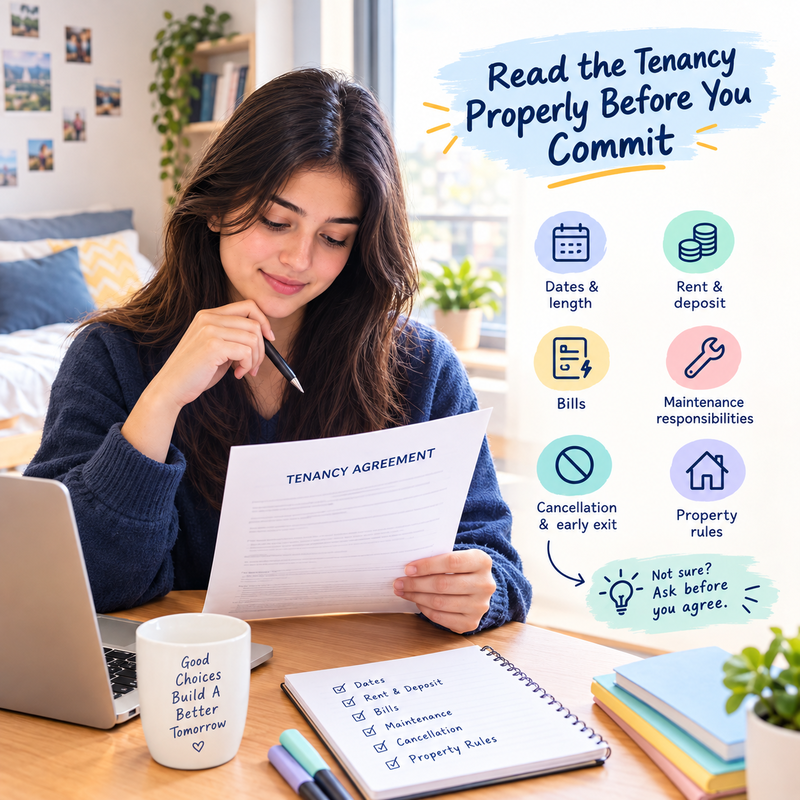
Read the Tenancy Properly Before You Commit
Once you've found a place you like the look of, it's time to go through the paperwork. Check the tenancy or licence period, the start and end dates, how rent gets paid and what's needed for the deposit. Go through the sections on bills, who's responsible for maintenance, what happens if you need to cancel or end early, and any property rules. It's also worth checking what happens if your circumstances change partway through the agreement.
Not every provider uses the same type of agreement. UWE Bristol's 2026/27 accommodation terms, for example, describe it as a licence rather than a tenancy. What matters is understanding exactly what kind of agreement applies to the specific property you're looking at. If something doesn't make sense, ask before you agree to it.
Compare Properties Using the Same Checklist Every Time
Once you've got a shortlist, go through each one using the same set of questions. That way you're not just comparing photos or whichever rent number jumps out first.
| What to compare | What to check |
|---|---|
| Property type | House, flat, ensuite room or private studio |
| Rent | Weekly or monthly amount and when it's due |
| Bills | What's included, what's separate |
| Deposit | How much and when it's due |
| Contract | Length, start date, end date |
| Private space | Bedroom, bathroom, kitchen or kitchenette |
| Shared space | Communal areas and shared facilities |
| Study space | Desk, workspace, room layout |
| Location | University, shops, everyday services |
| Travel | Walking, cycling or public transport |
| Additional costs | Internet, laundry, transport, anything else |
| Tenancy conditions | Cancellation, maintenance, house rules |
Two student properties may have similar advertised rents but offer very different living arrangements. One might include a private bathroom and kitchenette, while another may have shared cooking and living spaces. Record the details for each option, compare the full costs and read the agreement carefully before making your decision.
Finding Somewhere That Actually Fits What You Need
Once you've weighed up property types, the real cost of the tenancy, how the space fits your lifestyle, your commute, and the contract terms, you should have a much clearer idea of what you're looking for.
Frequently Asked Questions
-
Mostly you're choosing between shared houses, flats, ensuite rooms or private studios. What really sets them apart is how the bathroom, kitchen and living space are arranged some you share, some you don't.
-
Rent's the obvious one, but also look at the deposit, how long the contract ties you in for, and which bills are actually included versus what you'll be paying on top. Internet, laundry and getting around cost money too, and always ask upfront if there are any extra charges hiding somewhere; it's better to know before you sign than after.
-
It comes down to whether you can handle sharing space with people. From there, think about your actual habits. Do you need quiet to study, or can you work anywhere? Do you want your own storage for all your stuff? Just think through a normal week in your head and ask if this place would actually work for it.
-
Photos only tell you so much. Go through the actual listing details: room size, layout, what furniture's there, storage, the bathroom, whether it's a full kitchen or just a kitchenette, study space, shared areas, laundry, what bills cost, where it is, and how easy it'll be to get around from there.
-
Take the time to actually read it: dates, when rent's due, the deposit, what bills cover, how cancellations work, who's responsible for maintenance, and any house rules. If anything's unclear, ask before you put your name on it.
If you're checking out student accommodation Filton, we at Zest Student Accommodation currently have private ensuite studios at 166 Gloucester Road North, Filton, each with its own bathroom and kitchenette, shared communal spaces, and on-site laundry. Our current listing: it's about a 25-minute walk to UWE Frenchay Campus, most bills are included, and electricity runs through a separate top-up meter. Always double-check the latest property details, pricing, facilities, and tenancy terms before deciding, since these things can change year to year.